Personalized Medical Care & Dedicated International Patient Concierge

Medical Guide
Dr. Jong-Yeol Kim: What Thirty Years in OB/GYN Buys
A board-certified OB/GYN with three decades in a single specialty. What that record supports, where the clinic's statements stop, and how to read both.
Schedule a ConsultationMedically reviewed by Dr. Yu-Jin Oh, MD, Board-Certified Obstetrician-Gynecologist, Golden Balance Clinic
Doctor profiles are the least useful pages on most clinic websites. They list a degree, a number of years and a philosophy, and the reader finishes them knowing roughly what they knew before.
The information a patient actually needs is narrower and harder to find: what this person is qualified in, how long they have been doing it, what part of the work they do themselves, and which of the claims on the page are backed by something checkable.
This is an attempt at that version for Dr. Jong-Yeol Kim, the Medical Director of Golden Balance Clinic — including the point at which the clinic's statements stop, because a profile that reports only the flattering entries is an advertisement.
The documented record

Four facts, as the clinic publishes them.
Board-certified obstetrician-gynecologist. This is the load-bearing item and the one worth understanding properly. Board certification in Korea means completing a residency in the specialty and passing the specialty board examination; it is the formal marker that a physician trained in that field rather than moved into it. In a market where intimate-health procedures are offered by clinicians from several different backgrounds, knowing which specialty someone actually completed is a more useful question than it first appears.
Hallym University College of Medicine. Where he graduated.
Internship and residency in obstetrics and gynecology at Hallym University Sacred Heart Hospital. A university hospital training pathway in the specialty he practices.
Thirty years in practice as an obstetrician and gynecologist. Not thirty years in medicine generally — thirty in this field.
Regular member of the Korean Society of Obstetrics and Gynecology. The national specialty society for the field. Membership is an affiliation rather than a qualification, and it is listed here because it is what the clinic documents, not because it carries more weight than it does.
He is Medical Director of the clinic, which the clinic describes as having operated for more than two decades.
Where the published statements stop
Worth stating plainly, because what a profile declines to assert is part of reading it.
What the clinic states about him is the five items above and nothing further. In particular it does not state a subspecialty technique, a procedure volume, a publication record, a list of conference presentations, an award, or a teaching role.
Two things follow.
First, nothing in this article will describe a subspecialty qualification, a fellowship or a number of procedures performed, because none is documented. Where you see those claims about any clinician, ask where they come from.
Second, the clinic's own summary of its data describes its doctor information as clinic-reported and not independently verified. That is an unusually candid thing for a clinic to publish about itself, and it is the right frame for everything above: these are the clinic's statements about its director, offered as such.
Board certification, read from the United States
American readers tend to map "board-certified" onto the system they know, and the mapping is close enough to be useful and loose enough to mislead. A short explanation is worth the space, because this is the single credential the whole profile rests on.
In the United States, a specialist completes medical school, then a residency in the chosen specialty, then sits an examination set by the relevant specialty board. Certification is the result, and maintaining it involves ongoing requirements.
Korea's system follows the same logic: medical school, then a specialty residency at an approved training hospital, then the national specialty board examination. A physician who passes is a specialist in that field. The shape is the same even though the issuing bodies and the administrative details are not.
Two practical conclusions follow for a patient reading from abroad.
The claim is specific, so hold it to its wording. "Board-certified obstetrician-gynecologist" names a field. "Specialist", "expert", "aesthetic physician" and similar terms do not, and in a field where intimate procedures are offered by clinicians from several different backgrounds, the difference is exactly the thing you wanted to know. Asking which specialty board, in which field, is a fair and answerable question.
Certification is a floor, not a ranking. It establishes that someone completed training in the field and passed its examination. It says nothing about how often they perform a particular procedure, how they handle complications, or whether they will tell you not to proceed. Those are separate questions, and they are the ones worth spending your consultation on.
What the record here supports is the first of those: Dr. Kim trained in obstetrics and gynecology at a university hospital, certified in it, and has practiced in it since. For a patient weighing an intimate-health procedure, that is the relevant background rather than an adjacent one — and it is the specific thing to confirm about any clinician you are considering, in Korea or anywhere else.
What thirty years in one specialty actually buys
It is worth being specific, because "experienced" is the emptiest word in this field.
Pattern recognition for the unusual. The value of a long career is not in the routine case, which a competent clinician handles at five years as well as at thirty. It is in recognizing the case that does not fit — the symptom with an unexpected cause, the presentation that looks like one thing and is another. That is accumulated exposure, and it cannot be acquired any faster than it is acquired.
Knowing what not to do. Clinicians early in a career tend toward intervention; clinicians late in one have usually watched enough interventions produce nothing to have become harder to persuade. In elective care, where the question is often whether to treat at all, that disposition is worth more than technical speed.
Calibration about outcomes. Someone who has followed patients for years knows which results hold and which fade, and tends to describe expected outcomes in narrower terms than a brochure does.
What it does not buy is any assurance about your case — and here the clinic's own published guidance is firm. Its instruction for this category of treatment is to use factual, treatment-specific descriptions and to avoid claims of assured results, lasting rejuvenation, better sexual response or freedom from risk. A thirty-year record does not change that, and a clinician invoking their experience as a reason to expect a particular outcome has stepped outside what experience can support.
The specializations listed, and the one that is not profiled
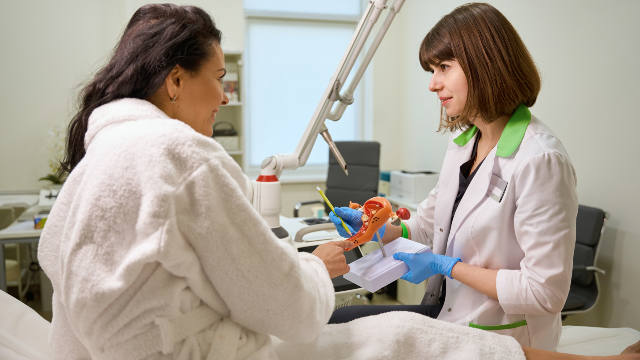
The clinic lists his core specializations as obstetrics and gynecology, feminine plastic surgery, vaginal fillers, and Q-Sculpt — the clinic's name for its HIFU vaginal tightening service.
One observation worth making. Of those four, the first three map onto service profiles the clinic publishes in detail. Q-Sculpt does not have its own published procedure profile: it appears as a named specialization and in the director's biography, while the clinic's documented non-surgical intimate treatments are profiled individually under other names. A patient interested in it should therefore ask for the specifics directly — what it involves, what candidacy looks like, how many sessions, what the evidence behind it is — rather than assuming a published description exists.
That is not a criticism so much as a practical note. It is also consistent with how the clinic treats this category generally: cautiously, with the limits stated.
What a Medical Director does, and why it matters to you
The title means something operationally rather than ceremonially.
The clinic documents a model in which treatment is planned by the responsible physician following a one-to-one assessment. It documents a stated limit of two surgeries per day, closed-circuit recording in all surgery and procedure rooms, and an explicit position against unnecessary over-treatment.
Those four together describe a particular way of running a practice: fewer cases, each planned individually, recorded, with a stated brake on upselling. Whether they are delivered is something a patient can only partly verify, but they are specific enough to ask about — and specific claims are the only kind worth testing.
The questions that test them are simple. Who will examine me? Will that person perform the procedure? How many procedures are scheduled on my day? What is recorded, and how long is it kept?
Two surgeries a day, read closely
Of the operational commitments the clinic publishes, this is the one that repays attention, because it is the only one that costs the clinic something.
Most of what clinics publish about how they work is free to say. A stated daily surgical limit is not: it caps what the practice can do in a day, and it is the kind of claim a patient could in principle notice being broken.
What it plausibly buys, if delivered, is unhurried scheduling — time between cases, a surgeon who has not already operated three times that morning, and room for an appointment to run long without the next one collapsing. In elective surgery, where nothing is urgent and the quality of the discussion beforehand matters, that is worth more than it sounds.
What it does not buy is any particular result, and it should not be read as a proxy for skill. A low-volume practice is not automatically a careful one, and the published limit tells you about the schedule rather than about the surgeon.
The way to use it is as a question rather than a reassurance. Ask how many procedures are booked on the day you are offered, who else is being seen, and how much time is set aside for your consultation and your operation. A clinic that has made the commitment can answer those directly; the answers are also the practical information you need for your own travel planning.
The clinic pairs that limit with closed-circuit recording in all surgery and procedure rooms and with a stated position against unnecessary over-treatment. The recording commitment carries its own fair question, which is who may view the footage and for how long it is retained — reasonable to ask, and more reasonable still to ask before rather than after.
The practice he directs
A director's profile is incomplete without the thing being directed, and the clinic's published description of itself is specific enough to be useful.
It is a gynecology and women's health practice in Gangnam, Seoul, on the twelfth floor of the Chunglim Building on Gangnam-daero. It has three physicians, two of whom are obstetrician-gynecologists, and an English-speaking global coordinator who handles international patients. Its services span medical gynecology, pelvic floor and urinary care, feminine plastic surgery, non-surgical intimate treatments, and aesthetic procedures.
Its hours are unusual by American standards and worth knowing if you are planning a trip: ten in the morning until nine at night, seven days a week, with a lunch break around the middle of the day and last registration two hours before closing. Holiday schedules are announced separately.
Three things follow for an international patient.
Scheduling is more flexible than you may expect. Evening and weekend appointments are the norm rather than a concession, which makes it easier to fit a consultation and a separate procedure visit into a short trip.
A small physician team means the clinician you book is the clinician you see — provided you name them. With three physicians rather than thirty, a request for a specific doctor is a practical one, and it should be made in writing before you travel.
The international interface is a person, not a form. A named coordinator handling foreign-patient messages is how questions reach the physician and come back in English, which matters when the alternative is a generic inbox.
None of this is a reason to choose a clinic on its own. It is the context a director's record sits in, and the part of it you can actually verify against your own calendar.
How to verify a clinician yourself
For a Korean physician, from the United States, this is harder than it should be, and most of the usual American routes do not apply.
What you can do:
Ask for the specialty in writing, named exactly. "Board-certified obstetrician-gynecologist" is a specific claim; "specialist" alone is not.
Ask where the residency was completed, and in what field. A residency in the specialty being practiced is the single most relevant training fact.
Ask who performs the procedure, and get it in writing before you travel.
Notice where the claims stop. A clinic whose profile asserts five specific things and declines to assert a sixth is telling you something about how it handles the rest.
Treat registrations as what they are. Golden Balance Clinic is a Registered Medical Institution for Attracting Foreign Patients under Korea's Ministry of Health and Welfare. That is the statutory listing permitting a clinic to treat foreign patients. It is not a quality accreditation, not an endorsement of outcomes, and not a statement about any individual clinician's credentials. It is worth having; it is not what an American reader may assume the word "registered" implies.
The clinic's team is listed on its doctors page, and the practice as a whole is described on the about page.
What to make of all this
A reasonable reading is this. The director's training and specialty are documented and consistent — a university-hospital residency in obstetrics and gynecology, board certification in that field, and three decades of practice in it. The operational commitments the clinic publishes are specific enough to ask about. And the areas the clinic has left unfilled are left visibly unfilled rather than papered over.
What that supports is a decision to have a consultation, not a decision to have a procedure. The second one is made after an examination, by you, with the alternatives in front of you — and for elective intimate-health care in particular, the published evidence counsels going slowly, whoever the clinician is.
A long record earns a careful hearing. It does not replace the assessment, and no serious clinician would suggest otherwise.
Frequently Asked Questions
What is Dr. Kim's specialty?
He is documented as a board-certified obstetrician-gynecologist, having completed internship and residency in obstetrics and gynecology at Hallym University Sacred Heart Hospital after graduating from Hallym University College of Medicine.
How long has he been practicing?
The clinic documents thirty years of practice as an obstetrician and gynecologist — three decades in this specialty rather than in medicine generally.
Does he have a subspecialty fellowship?
The clinic states no subspecialty technique for him, so none is claimed here. He is documented as a regular member of the Korean Society of Obstetrics and Gynecology, which is an affiliation rather than a further qualification. Where a subspecialty claim appears anywhere, ask what it is based on.
What does the clinic say about how it runs procedures?
It documents treatment planned by the responsible physician after a one-to-one assessment, a stated limit of two surgeries per day, closed-circuit recording in all surgery and procedure rooms, and a position against unnecessary over-treatment.
Is the clinic accredited?
It is a Registered Medical Institution for Attracting Foreign Patients under the Ministry of Health and Welfare. That is a statutory registration permitting treatment of foreign patients — not a quality accreditation and not a statement about any clinician's credentials.
What is Q-Sculpt?
It is the clinic's name for its HIFU vaginal tightening service and appears among the director's listed specializations. It does not have its own published procedure profile, so ask for the specifics directly rather than assuming a detailed description exists.
Does experience mean a better outcome for me?
No one can promise that, whatever their record. The clinic's own published guidance for this category tells writers to avoid claims of assured results, and a long record does not override what the evidence in elective intimate care does and does not support.
How can I check any of this from the US?
Ask for the specialty and residency in writing, named exactly; ask who will examine you and who will operate; and read an unfilled entry as information rather than as an oversight.
The Bottom Line
- The documented record is specific and internally consistent: board-certified obstetrician-gynecologist, Hallym University College of Medicine, internship and residency in the specialty at Hallym University Sacred Heart Hospital, thirty years in practice, regular membership of the national specialty society, and the role of Medical Director at a clinic that has operated for more than two decades.
- The published statements stop where the clinic's knowledge does — no subspecialty technique, procedure volume, publication record, award or teaching role is asserted, and the clinic describes its doctor information as clinic-reported and not independently verified.
- Thirty years in one specialty buys pattern recognition for the unusual case and a disposition against unnecessary intervention; it does not buy a prediction about your result.
- Q-Sculpt is listed among his specializations but has no published procedure profile, so ask for its specifics directly.
- The Ministry of Health and Welfare entry is a registration permitting the clinic to treat foreign patients. It is not a quality rating, and not what an American reader may assume the word "registered" implies.
This article is for general informational purposes and does not constitute individualized medical advice. It is not a self-diagnosis tool, and a clinician's record does not establish that any treatment is appropriate for you. Only a qualified gynecologist who has examined you can advise on that.
More Articles
Continue reading our clinical guides.
Verifying Injectable Products and Dosage at a Korean Clinic
What you can actually check before a syringe is filled: the packaging, the product, the quantity, and the questions that have answers worth hearing.
Learn More
Verifying a Clinic's Safety Promises Before You Travel
A published safety policy you cannot check is a slogan. The questions that turn one into something testable, and how to read the answers you get.
Learn More
Reading Before-and-After Photos Critically Before You Book
A results gallery is a sample someone chose. What changes an outcome photograph, what a credible gallery labels, and how to use one without being misled by it.
Learn More