Personalized Medical Care & Dedicated International Patient Concierge

Semi-Permanent Makeup · Consultation Required
Facial Contour Micropigmentation
Facial contour micropigmentation refers to depositing pigment into the skin to create or enhance selected facial features.
Schedule a ConsultationFacial Contour Micropigmentation in Seoul, Republic of Korea

Medically reviewed by Dr. Eun-Young Kwak, MD, graduate of Yonsei University College of Medicine Golden Balance Clinic, Gangnam-gu, Seoul
Facial contour micropigmentation refers to depositing pigment into the skin to create or enhance selected facial features. The term covers more than one technique, so the treatment area, the design and the method are clarified with the practitioner at consultation and agreed before any pigment is placed. What that agreement produces is a cosmetic change whose extent depends on the technique chosen, on pigment placement, and on how your own skin heals.
What Is Facial Contour Micropigmentation?
Facial contour micropigmentation is a pigment-based cosmetic procedure that places color into the skin to emphasize selected facial features, using a technique agreed in advance with the practitioner.
Procedure time is typically one to two hours.
The session follows a set order: the design is agreed, the skin is cleaned, the equipment is prepared, a numbing product is applied if suitable, pigment is placed, and aftercare instructions are given.
Pain control depends on the treatment area and the technique; a topical numbing product may be considered, and its use and suitability are confirmed with the practitioner.
Clarifying the exact micropigmentation technique is a formal step of the consultation, not an afterthought.
Symmetry, a particular facial shape, or a specific result cannot be guaranteed.
The treatment sits within Semi-Permanent Makeup at the clinic's Gangnam-gu address.
Because this is pigment placed in facial skin, the questions worth asking are about the materials as much as the design. The European Chemicals Agency describes these products as mixtures of many chemicals, some of them hazardous, and notes that pigment can travel out of the skin and reach organs including the lymph nodes and the liver. It also points out that substances used in them may remain in the body for life, so exposure is potentially long-term. Since January 2022 the EU has capped the use of more than 4,000 hazardous chemicals in these mixtures under the REACH Regulation, and the label must now name the intended use, list the ingredients and carry the relevant safety statements.
The complication that most often surprises people is the granuloma. The U.S. Food and Drug Administration describes granulomas as nodules that may form around material the body perceives as foreign, such as particles of tattoo pigment, and lists them among the primary complications of tattooing alongside infection, removal problems, allergic reactions and keloid formation. The same agency notes that people who plan to have facial cosmetic surgery are advised that the appearance of their permanent makeup may become distorted, and that pigments injected too deeply can migrate beyond the original sites and blur.
Who Performs Facial Contour Micropigmentation at Golden Balance Clinic

Dr. Eun-Young Kwak
Plastic Surgery/Petit Center Doctor
The first job of the consultation is to establish precisely which technique is being discussed, because the word covers several of them.
Dr. Eun-Young Kwak is the performing doctor for this treatment and reviewed this page.
Dr. Eun-Young Kwak is a Director and the doctor who leads the clinic's plastic surgery and petit centre. She graduated from Yonsei University College of Medicine. She is a member of the Korean Academy of Women's Aesthetic Medicine, the Korean Aesthetic Wellbeing Society, the Korean Society for Obesity and Plastic Surgery, and the Korean Society of Anti-Aging Medicine, and she previously served as a director of I-Love Petit Clinic and of Petit Queen Clinic.
The consultation runs in five steps: discuss the facial appearance you want and your treatment goals; review medical history, allergies, skin conditions, medications and previous cosmetic procedures; assess the proposed treatment area and clarify the exact micropigmentation technique; explain the pigment, the expected results, the risks, the limitations and the aftercare; and confirm suitability and obtain informed consent before treatment. Where residual pigment from earlier work has changed color or is still visible, the options are evaluated against that starting point.
Who Is a Good Candidate for Facial Contour Micropigmentation?
Adults seeking a cosmetic change who understand the treatment's limitations and its potential risks.
People whose suitability has been assessed against the exact technique proposed, their skin condition, allergies, medical history and desired outcome.
Those content with a result described as an enhancement of selected features rather than a defined facial shape.
People with an active skin infection or inflammation at the treatment site may need to postpone treatment.
Anyone with a history of pigment allergies, keloid scarring, or impaired healing should discuss their individual risks with a qualified healthcare professional first.
What to Expect: Procedure, Recovery, and Results Timeline

Preparation is a two-way exchange. Disclose relevant medical conditions, allergies, skin concerns, medications and previous cosmetic treatments; then ask which pigments and devices will be used, and discuss the planned design until you can picture it. Patient guidance on pigment procedures suggests two further questions: what sterilisation and single-use practice the room runs on, and under what conditions the pigments themselves are kept. Follow the practitioner's preparation instructions, avoid treatment over infected, irritated or broken skin, and never stop prescribed medication without medical advice.
On the day, the design is agreed, the skin is cleaned, the equipment is prepared, a numbing product is applied if it is suitable for the area and technique, pigment is placed into the skin, and you leave with aftercare instructions. Some discomfort, stinging or tenderness may occur because the procedure involves the skin, and how much varies by person and by area.
Stage | What to expect |
|---|---|
Procedure time | Typically 1 to 2 hours |
Pain control | Depends on area and technique; a topical numbing product may be considered |
Redness and sensitivity | May settle within 1 to 2 weeks, with healing continuing afterwards |
Initial results visible | Within 2 to 4 weeks |
Healed appearance assessed | At approximately 4 to 6 weeks |
Stay in Korea | Allow 1 to 2 days, subject to advice and whether an in-person follow-up is required |
Flying home | Same day or next day if you feel well and the practitioner has no concerns |
Aftercare follows whatever the practitioner has written down. Keep the treated area clean as directed and avoid touching it with unwashed hands. Ask which skincare products and makeup should be avoided during healing — that list is specific to the technique used, so it is not safe to assume. Seek medical advice for worsening redness, pain, swelling, discharge, or other signs of infection.
The possible benefits, depending on the actual technique, are emphasis of selected facial features or a longer-lasting cosmetic effect. Results depend on pigment placement, skin response and individual healing, and longevity depends on skin type and aftercare. Symmetry, a particular facial shape, or a specific result cannot be guaranteed, and that limit is part of the discussion rather than a disclaimer bolted on at the end.
The potential risks of pigment-based procedures are redness, swelling, infection, allergic reactions, scarring, granulomas, pigment migration, discoloration, and difficulty removing the pigment. Some people may develop raised areas around the pigment. One risk deserves its own sentence, because it is not intuitive: contaminated pigment can cause infection even when the container appears sealed.
Difficulty of removal is the reason the design conversation matters. The American Society of Plastic Surgeons sets out why: ink particles are considered permanent because the immune system cannot clear them, laser work fragments them instead, and the number of treatments needed runs anywhere from one to ten according to a tattoo's design, its size and its shades. Each treatment leaves an open wound requiring daily cleaning and dressing until it heals, roughly five days later.
Combining Facial Contour Micropigmentation with Other Treatments
If you are considering injectable filler treatments, laser treatments, facial surgery or other cosmetic procedures, ask qualified practitioners about treatment order and timing.
Ask specifically whether one procedure could alter the appearance of the other, in either direction.
Alternatives rather than additions include temporary makeup, which can be adjusted or removed daily, and other cosmetic procedures that address facial contour or definition differently without being equivalent to micropigmentation.
Safety, Precision, and Clinic Standards
The passages below are the clinic's own published statements about its practice, reproduced word for word.
The clinic states its philosophy as: "We are committed to personalized 1:1 treatment plans tailored to each patient's condition and prioritize safety above all else in every procedure."
The clinic states that it carries out individualized pre-procedure consultations, limits surgeries to two per day, installs CCTV in all surgery and procedure rooms, and avoids unnecessary over-treatment.
Golden Balance Clinic is registered as a Medical Institution for Attracting Foreign Patients with the Republic of Korea's Ministry of Health and Welfare, under the Medical Overseas Expansion and Foreign Patients Attraction Act. That is a registration for treating international patients; it is not a facility accreditation.
English-language support is available through designated marketing, consultation, and global coordination staff, and the clinic names Scarlett Kim as its global coordinator, available from 10:00 to 20:00 KST.
Golden Balance Clinic is on the 12th floor of the Chunglim Building at 468 Gangnam-daero, Gangnam-gu, Seoul 06123, Republic of Korea. The clinic is open Monday to Sunday from 10:00 to 21:00 KST year-round, with a lunch break from 11:30 to 12:30 KST and last registration at 19:00 KST.
Where the procedure itself is loosely defined, the standards for how it should be discussed are not. The General Medical Council asks that whoever offers a cosmetic intervention works only within what they are competent to do, obtains the patient's consent themselves, explains the likely outcome and the risks without euphemism, leaves the patient room to reflect, considers vulnerability and psychological need, and advertises honestly. The National Health Service adds the patient-side counterpart: learn as much about the procedure as you can, put questions to the practitioner about materials and about failure modes, distrust what social media shows you, and let the decision sit for a while.
The Bottom Line
Pigment is placed in facial skin to emphasize selected features, using a technique agreed with the practitioner first.
Sessions typically run one to two hours, with pain control decided by area and technique.
Redness and sensitivity may settle within one to two weeks; initial results appear within two to four weeks.
Symmetry, a particular facial shape, or a specific result cannot be guaranteed.
Granulomas, pigment migration and difficulty of removal are on the risk list, and contaminated pigment can cause infection even from a sealed-looking container.
Frequently Asked Questions
What exactly will be done to my face?
That is settled in the consultation, where clarifying the exact micropigmentation technique is a formal step before anything else is agreed. Different techniques sit under the same name, so the area, the design and the method are confirmed and explained to you, along with the pigment, the expected results, the risks and the limitations, before consent is taken.
Will it make my face symmetrical?
No procedure can promise that, and this one does not claim it. Symmetry, a particular facial shape, or a specific result cannot be guaranteed. What can reasonably be said is that the technique may enhance selected features, that results vary by individual, and that suitability and expected outcomes belong in the consultation.
What is a granuloma?
It is a nodule that can form around material the body treats as foreign, including particles of tattoo pigment. The FDA lists granulomas among the primary complications of tattooing. Some people also develop raised areas around pigment, which is the same phenomenon described in everyday language, and it is one reason the aftercare instructions ask you to report changes.
How do I judge whether the clinic's hygiene is adequate?
Ask three direct questions: what is sterilised between patients, which components are discarded after a single use, and where the pigments are kept between appointments. Patient guidance for pigment procedures points to exactly those. Contaminated pigment can cause infection even when the container appears sealed, so storage and handling are not pedantic details.
Can I have fillers or laser work around the same time?
Ask about order and timing before you book either, and ask whether one treatment could change the appearance of the other. The sequence is a clinical decision that depends on what each procedure does to the same patch of skin. Facial surgery is the clearest example: pigment placed before an operation may look different afterwards.
How long does it last, and can it be undone?
Initial results appear within two to four weeks, and longevity depends on skin type and aftercare. Undoing it is the harder half of the question: pigment is not easily withdrawn, laser treatment generally runs to several appointments at six-week intervals, and some shades never clear completely. Plan the design as something you will live with for a long time.
How long should I allow in Korea?
One to two days is a reasonable allowance, subject to the practitioner's advice and whether an in-person follow-up is needed. Flying home the same day or the next is usually possible if you feel well and there are no concerns. Confirm travel timing before treatment rather than after it, especially if unexpected swelling or pain develops.
Book a Consultation at Golden Balance Clinic
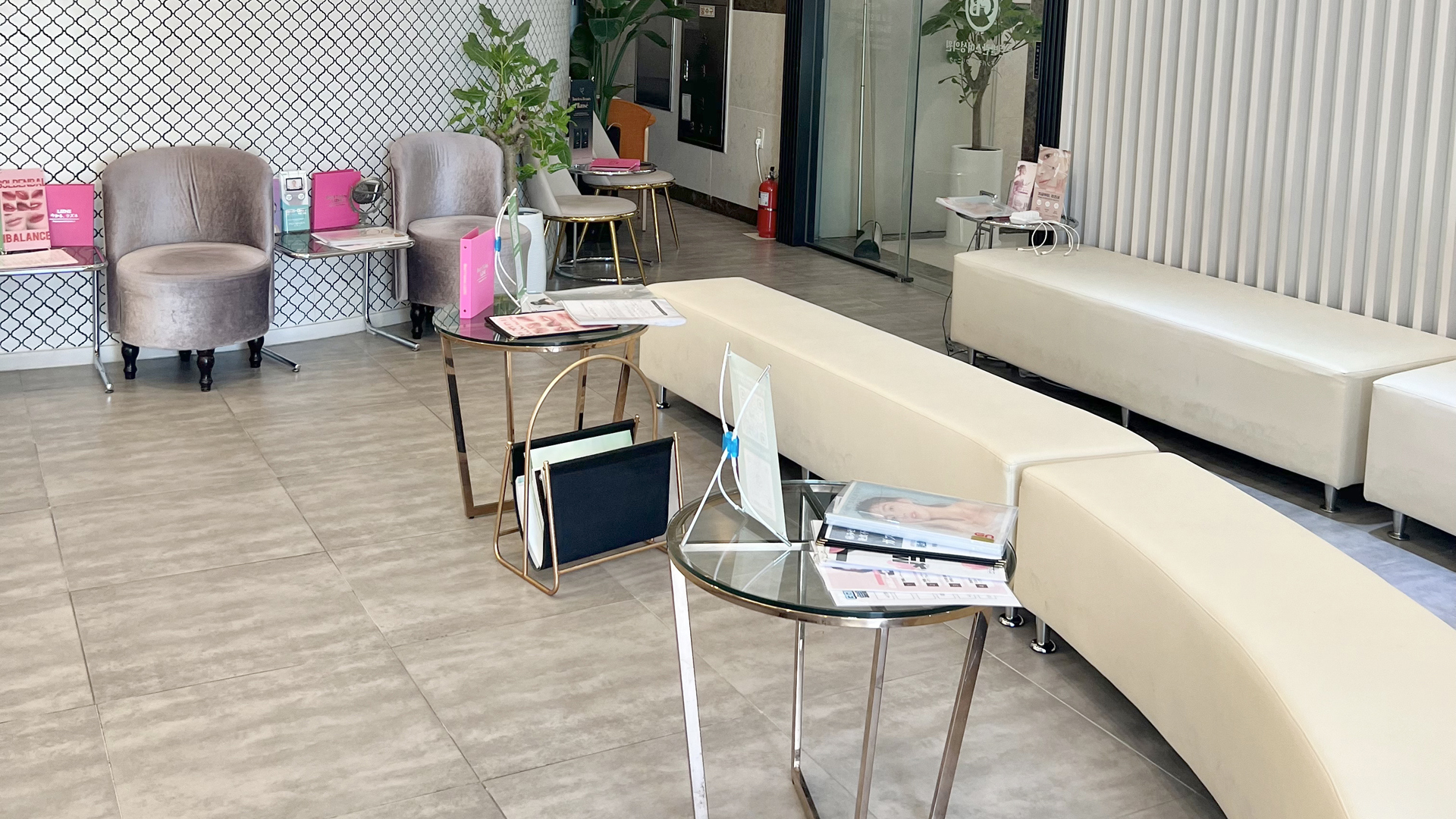
Facial contour micropigmentation is carried out at Golden Balance Clinic in Gangnam-gu, Seoul, typically in a session of one to two hours, once the technique and design have been agreed at consultation. You can view photographs taken at the clinic via clinic's gallery.
Contact Golden Balance Clinic through the clinic contact page, by phone on +82-2-516-7148, or by email at info@goldenbalanceclinic.com.
Disclaimer
For informational purposes only. Individual results may vary depending on each patient's medical history, physical condition, anatomy, treatment plan, and recovery. The suitability of gynecological, aesthetic, dermatological, injectable, and other medical procedures should be determined through an individual consultation with a qualified medical professional. All treatments may involve potential risks, side effects, and recovery requirements, which should be discussed before treatment. Information provided by Golden Balance Clinic does not replace professional medical advice, diagnosis, or treatment. Results may vary and individual experiences may differ.
Sources & Further Reading
European Chemicals Agency — tattoo inks and permanent make-up: the hazardous substances these mixtures may contain, migration of pigments to organs such as the lymph nodes and liver, long-term presence in the body, and the EU limits and labelling rules in force since January 2022.
Food and Drug Administration — fact sheet on tattoos and permanent makeup: granulomas as nodules forming around pigment particles, the primary complications of tattooing, distortion of permanent makeup after facial cosmetic surgery, and blurring from over-deep pigment.
American Society of Plastic Surgeons — tattoo removal: why ink particles persist, the number of laser sessions typically required, the six-week interval between them, and the colors that resist removal.
General Medical Council — standards for cosmetic interventions, including competence, consent sought personally, clear discussion of outcome and risks, and time for reflection.
National Health Service — advice before a cosmetic procedure, including researching the procedure, asking what products will be used and what could go wrong, and taking time to decide.
Other Services
Explore additional treatments offered by our specialists.
Eyebrow Semi-Permanent Makeup
Eyebrow semi-permanent makeup is a cosmetic tattooing procedure that deposits pigment into the skin to enhance eyebrow shape, definition, and color.
Learn More
Facial Contour Micropigmentation
Facial contour micropigmentation refers to depositing pigment into the skin to create or enhance selected facial features.
Learn More
Eyeliner & Eye Enhancement PMU
Eyeliner PMU is a cosmetic tattooing procedure that deposits pigment into the skin around the eyelids to create a longer-lasting eyeliner effect.
Learn More