Personalized Medical Care & Dedicated International Patient Concierge

Dermatology & Laser Treatments · Consultation Required
Laser Tattoo Removal
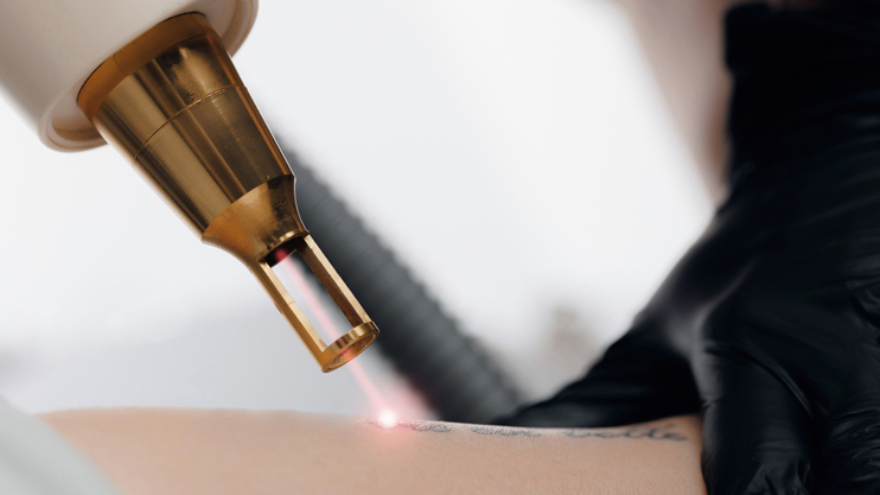
Laser tattoo removal uses concentrated light energy to break tattoo pigment into smaller particles, which the body's immune system gradually clears.
Schedule a ConsultationLaser Tattoo Removal in Seoul, Republic of Korea

Medically reviewed by Dr. Eun-Young Kwak, MD, graduate of Yonsei University College of Medicine, and Dr. Yu-Jin Oh, board-certified obstetrician-gynecologist Golden Balance Clinic, Gangnam-gu, Seoul
Laser tattoo removal uses concentrated light energy to break tattoo pigment into smaller particles, which the body's immune system gradually clears. Multiple sessions are generally required, because the fading happens in the weeks between visits rather than during the appointment itself. How far a given tattoo fades depends on its ink colours, how deep the pigment sits and how the individual heals.
What Is Laser Tattoo Removal?
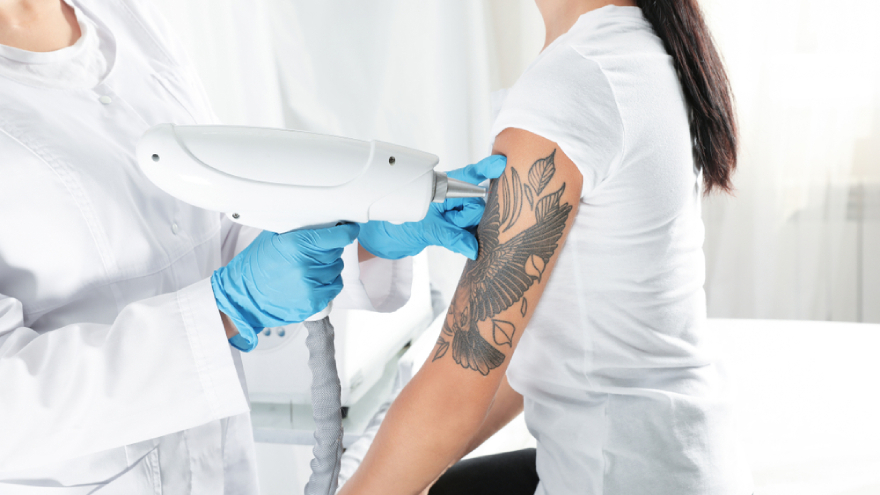
Laser tattoo removal is the use of targeted light pulses to shatter tattoo ink into fragments small enough for the body to carry away, repeated over a planned course of treatments.
A session typically lasts 10 to 30 minutes.
Sessions are spaced to allow healing before the next one.
The clinician directs the selected laser over the tattoo in short pulses.
Ink colour, depth, tattoo age, size and location all affect what is achievable.
This treatment belongs with the rest of the clinic's Dermatology & Laser Treatments work in Gangnam-gu.
The body is doing most of the work, and that is the part patients tend not to expect. The American Academy of Dermatology puts it plainly: when the laser's light hits the ink, it shatters the ink into tiny particles, and the body — not the laser — must then flush those particles out. The same organisation explains why more than one session is needed: a tattoo artist layers the ink, a laser cannot safely break down all of those layers at once, and the skin needs time to heal in between. After each treatment, the tattoo should lighten.
Colour is the other variable that drives everything. Queensland Health's guidance on light-based cosmetic services notes that laser devices target the pigment in ink using very specific wavelengths of light, and that different colours require different wavelengths — which is why a single wavelength cannot address every tattoo equally. The same page states that intense pulsed light devices are not suitable for tattoo removal at all, a useful distinction for anyone comparing advertised treatments.
North Bristol NHS Trust's laser service adds a detail that explains why ink stays put in the first place: the body forms a fibrous coating around the pigment particles so they are not absorbed and removed, and short bursts of laser energy break up both the pigment and that coating so the body can take the particles away. Its patient information also reports that Indian ink and single-colour black or red tattoos usually respond well, while green, blue, purple and orange do not respond as well, and that treatments are spaced at least eight weeks apart to give the body time to absorb the pigment.
Evidence on how much can be cleared has been gathered formally. A systematic review in the Journal of Cosmetic Dermatology examining neodymium-doped yttrium-aluminium-garnet lasers concluded that they provide effective clearance of black and blue tattoos but require multiple sessions, and that professional tattoos and coloured pigments remain treatment challenges. Its authors also noted that high-quality comparative trials with standardised outcome measures are still needed to clarify the relative benefits of picosecond and nanosecond systems.
Who Performs Laser Tattoo Removal at Golden Balance Clinic
|
|
Dr. Eun-Young Kwak | Dr. Yu-Jin Oh |


Responsibility for this treatment sits with the same two doctors who cover the clinic's dermatological and laser work.
The lead of that group is Dr. Eun-Young Kwak, who directs the clinic's plastic surgery and petit centre. Both doctors perform this service; the clinic does not assign it to one of them. If you want to know in advance which of them you will see, ask when you book rather than assuming from the page.
Dr. Eun-Young Kwak is a Director and the doctor who leads the clinic's plastic surgery and petit centre. She graduated from Yonsei University College of Medicine. She is a member of the Korean Academy of Women's Aesthetic Medicine, the Korean Aesthetic Wellbeing Society, the Korean Society for Obesity and Plastic Surgery, and the Korean Society of Anti-Aging Medicine, and she previously served as a director of I-Love Petit Clinic and of Petit Queen Clinic.
Working alongside her is Dr. Yu-Jin Oh, whose memberships include a society for medical aesthetics and dermatology.
Dr. Yu-Jin Oh is a Director and a board-certified obstetrician-gynecologist with 23 years of experience. She graduated from Jeonbuk National University Medical School, completed her internship at Samsung Medical Center Cheil General Hospital, and completed residency training in obstetrics and gynecology at Samsung Medical Center Kangbuk Samsung Hospital. She is a member of the Korean Society of Obstetrics and Gynecology, the Korean Academy of Functional Medicine, and the Korean Society of Medical Aesthetics and Dermatology.
Whichever doctor you see assesses the tattoo's size, location, age, pigment colours and depth, your skin tone, any previous removal attempts and your medical history. The consultation is also where realistic expectations, possible risks and the likely number of sessions are set out.
Laser Tattoo Removal Options Available
The clinic's record names a small set of alternatives, and they are not equivalent to each other.
Approach | What the record says about it |
|---|---|
Laser treatment | Fragments the pigment over a planned course of sessions so the body can clear it |
Surgical excision | May suit selected small tattoos, but leaves a scar |
Dermabrasion and ablative procedures | Carry risks of scarring and skin injury |
Removal creams and home kits | Not recommended as established effective alternatives |
That last row deserves emphasis rather than a footnote. The American Academy of Dermatology states that there is no evidence any tattoo-removal cream, ointment or do-it-yourself kit can remove a tattoo, and that such products often contain strong acids capable of causing a rash, a burn or a lasting scar — leaving the unwanted tattoo still in place. It also warns against salabrasion, the home technique of abrading the skin and rubbing salt into it, describing it as extremely painful and a route to serious infection and scarring.
Who Is a Good Candidate for Laser Tattoo Removal?
Adults who want to fade or remove an unwanted tattoo and have been assessed as suitable by a qualified medical professional.
People whose tattoo size, location, ink colours and depth, skin type, medical history and healing capacity have all been taken into account.
People comfortable with a course of visits rather than a single appointment.
Active infection or an unhealed wound in the treatment area may mean postponing.
Pregnancy or breastfeeding is identified as a reason to avoid treatment.
Suitability is an individual assessment, not a rule that can be applied from a description.
What to Expect: Procedure, Recovery, and Results Timeline
Before the first session, there are a few things to get in order. Avoid tanning, disclose your medications and medical conditions, and follow whatever instructions the clinician gives. Raise any history of abnormal scarring, any allergies and any earlier tattoo-removal treatments, because all three change the plan. Keep sun off the treatment area, and do not apply irritating products or have other skin treatments on the same area without the clinic's agreement.
On the day, the treatment area is examined and cleaned, protective eyewear is provided, and numbing may be considered. The clinician then directs the selected laser over the tattoo in short pulses. Afterwards the area is assessed and appropriate aftercare given, and treatment is repeated once the skin has had sufficient healing time.
As for how it feels: expect a snapping or stinging sensation against the skin, with the intensity varying by the tattoo's size and location and by the settings used. Depending on the tattoo and your needs, a clinician may use topical numbing cream.
Stage | What to expect |
|---|---|
Session length | Typically 10 to 30 minutes |
Pain control | Topical numbing cream where the clinician judges it useful |
Sensation | Snapping or stinging during the pulses |
Complete healing | 2 to 4 weeks after a session |
Visible fading | Developing over 4 to 8 weeks |
Course length | Multiple sessions, spaced several weeks apart |
Stay in Korea | One day may be enough for a single session |
Flying home | Generally the same day or the next, once the clinician confirms you are fit to travel |
Aftercare is short but not optional. Keep the area clean, follow the wound-care instructions you are given, leave blisters and scabs alone, and keep the skin out of the sun. Worsening pain, spreading redness, pus or fever are reasons to seek medical care rather than to wait for the next appointment.
Results are honest rather than dramatic. The tattoo may progressively fade over multiple sessions; some tattoos can be removed substantially, while others leave residual pigment or a visible outline. Fading occurs gradually in the weeks between sessions as the body clears the fragmented pigment, so the final judgement belongs at the end of the planned course and after sufficient healing — and the exact timeline depends on the tattoo and on individual response.
The side effects commonly reported are temporary redness, swelling, soreness and blistering, with pinpoint bleeding, scabbing and temporary lightening or darkening of the skin also possible. The fuller list of risks adds tenderness, infection, scarring, persistent pigment change, pigment reactions and incomplete removal. Queensland Health describes the usual reactions to a session as a heat or sunburn sensation, redness, mild swelling and minor scabbing, and advises anyone who ends up with a burn, scarring or an infection to seek medical advice urgently rather than wait. North Bristol NHS Trust adds two points worth knowing before a first session: treatment can occasionally make the skin's own pigment decrease or increase, leaving a pale or dark mark that usually returns to normal but can take a long time, and some light-coloured tattoo inks get darker after laser treatment.
Combining Laser Tattoo Removal with Other Treatments
This treatment is not combined with other energy treatments on the same area at the same time.
Spacing between sessions exists for healing, so adding something else to that area works against it.
Anything you want to do to nearby skin is a question for the clinician before the course starts, not during it.
Safety, Precision, and Clinic Standards
What follows is the clinic's published wording about its own practice, quoted as written.
The clinic states its philosophy as: "We are committed to personalized 1:1 treatment plans tailored to each patient's condition and prioritize safety above all else in every procedure."
The clinic states that it carries out individualized pre-procedure consultations, limits surgeries to two per day, installs CCTV in all surgery and procedure rooms, and avoids unnecessary over-treatment.
Golden Balance Clinic is registered as a Medical Institution for Attracting Foreign Patients with the Republic of Korea's Ministry of Health and Welfare, under the Medical Overseas Expansion and Foreign Patients Attraction Act. That is a registration for treating international patients; it is not a facility accreditation.
English-language support is available through designated marketing, consultation, and global coordination staff, and the clinic names Scarlett Kim as its global coordinator, available from 10:00 to 20:00 KST.
Golden Balance Clinic is on the 12th floor of the Chunglim Building at 468 Gangnam-daero, Gangnam-gu, Seoul 06123, Republic of Korea. The clinic is open Monday to Sunday from 10:00 to 21:00 KST year-round, with a lunch break from 11:30 to 12:30 KST and last registration at 19:00 KST.
The Bottom Line
Light pulses fragment the ink; the body clears the fragments over the following weeks.
Sessions run 10 to 30 minutes and are spaced to let the skin heal, so this is a course rather than a visit.
Healing after a session takes 2 to 4 weeks, with fading developing over 4 to 8 weeks.
Some tattoos fade substantially; others leave residual pigment or an outline, and ink colour is a major factor.
Redness, swelling, soreness, blistering and temporary pigment change are the usual effects; scarring and incomplete removal are among the risks.
Frequently Asked Questions
Why can't this be done in one appointment?
Tattoo ink is layered, and a laser cannot safely break down every layer in a single session. The skin also needs recovery time, and the body needs weeks to carry away the fragmented pigment. That is why the treatment is planned as a course with gaps built into it.
What does a session actually feel like?
Most people describe repeated snapping or stinging against the skin. How strong that feels depends on where the tattoo is, how large it is and what settings are used. Topical numbing cream may be applied depending on the tattoo and on what you need.
Will the tattoo disappear completely?
Sometimes, but not always, and nobody should promise it in advance. Some tattoos can be removed substantially; others end up with residual pigment or a faint visible outline. Ink colour, depth and the number of sessions completed all influence where a given tattoo lands.
How long does the skin take to settle after each visit?
Complete healing may take two to four weeks. Visible fading of the tattoo itself develops over roughly four to eight weeks, which is why the result is assessed between sessions rather than immediately afterwards.
Is there any reason I should not have this done?
Yes. Active infection or an unhealed wound in the treatment area may mean postponing, and pregnancy or breastfeeding is identified as a reason to avoid treatment altogether. Beyond those, suitability depends on an individual assessment of your skin, your medical history and the tattoo itself.
How should I plan the trip if I am coming from abroad?
A stay of one day may be sufficient for a single session, and you may generally fly home the same day or the following day once the clinician confirms you are fit to travel. Because multiple sessions are usually needed and are spaced several weeks apart, a full course normally means separate visits rather than one extended stay.
What should I watch for once I am home?
Keep the area clean, follow the wound-care instructions, resist picking at blisters or scabs, and keep the skin out of the sun. Worsening pain, spreading redness, pus or a fever all call for medical care. Should that arise once you have travelled, write to the clinic using the details below and have a doctor nearby examine the skin.
Book a Consultation at Golden Balance Clinic
Tattoo removal is carried out at the clinic in Gangnam-gu, Seoul, and the first appointment is an assessment of the tattoo rather than a treatment — the ink colours, the depth and your skin all have to be read before a plan can be set. The clinic publishes its own before-and-after photographs at clinic's gallery.
Contact Golden Balance Clinic through the clinic contact page, by phone on +82-2-516-7148, or by email at info@goldenbalanceclinic.com.
Disclaimer
For informational purposes only. Individual results may vary depending on each patient's medical history, physical condition, anatomy, treatment plan, and recovery. The suitability of gynecological, aesthetic, dermatological, injectable, and other medical procedures should be determined through an individual consultation with a qualified medical professional. All treatments may involve potential risks, side effects, and recovery requirements, which should be discussed before treatment. Information provided by Golden Balance Clinic does not replace professional medical advice, diagnosis, or treatment. Results may vary and individual experiences may differ.
Sources & Further Reading
American Academy of Dermatology — how laser light shatters ink that the body must then flush out, why layered ink needs more than one session, and the warning about removal creams, kits and salabrasion.
Queensland Government — wavelengths targeted to ink colour, the unsuitability of intense pulsed light for tattoo removal, and the common reactions after a session.
Journal of Cosmetic Dermatology — systematic review of Nd:YAG tattoo removal: effective clearance of black and blue tattoos over multiple sessions, with professional and coloured tattoos still difficult.
North Bristol NHS Trust — the fibrous coating the body forms around tattoo pigment, which ink colours respond best, the minimum eight-week spacing between treatments, and the pigment-change side effects.
Other Services
Explore additional treatments offered by our specialists.
Eyebrow Semi-Permanent Makeup
Eyebrow semi-permanent makeup is a cosmetic tattooing procedure that deposits pigment into the skin to enhance eyebrow shape, definition, and color.
Learn More
Facial Contour Micropigmentation
Facial contour micropigmentation refers to depositing pigment into the skin to create or enhance selected facial features.
Learn More
Eyeliner & Eye Enhancement PMU
Eyeliner PMU is a cosmetic tattooing procedure that deposits pigment into the skin around the eyelids to create a longer-lasting eyeliner effect.
Learn More