Personalized Medical Care & Dedicated International Patient Concierge

Eyelid Surgery · Consultation Required
Upper Blepharoplasty
Upper blepharoplasty is an operation that removes excess skin from the upper eyelids, and depending on the patient's anatomy and goals the surgeon may also address selected muscle or fat at the same time.
Schedule a ConsultationUpper Blepharoplasty in Seoul, Republic of Korea

Medically reviewed by Dr. Eun-Young Kwak, MD, graduate of Yonsei University College of Medicine Golden Balance Clinic, Gangnam-gu, Seoul
Upper blepharoplasty is an operation that removes excess skin from the upper eyelids, and depending on the patient's anatomy and goals the surgeon may also address selected muscle or fat at the same time. It is the procedure people usually mean when they talk about hooded or heavy upper lids. Where the excess skin reaches far enough to obstruct the visual field, surgery may improve that field in patients who have been assessed as suitable.
What Is Upper Blepharoplasty?
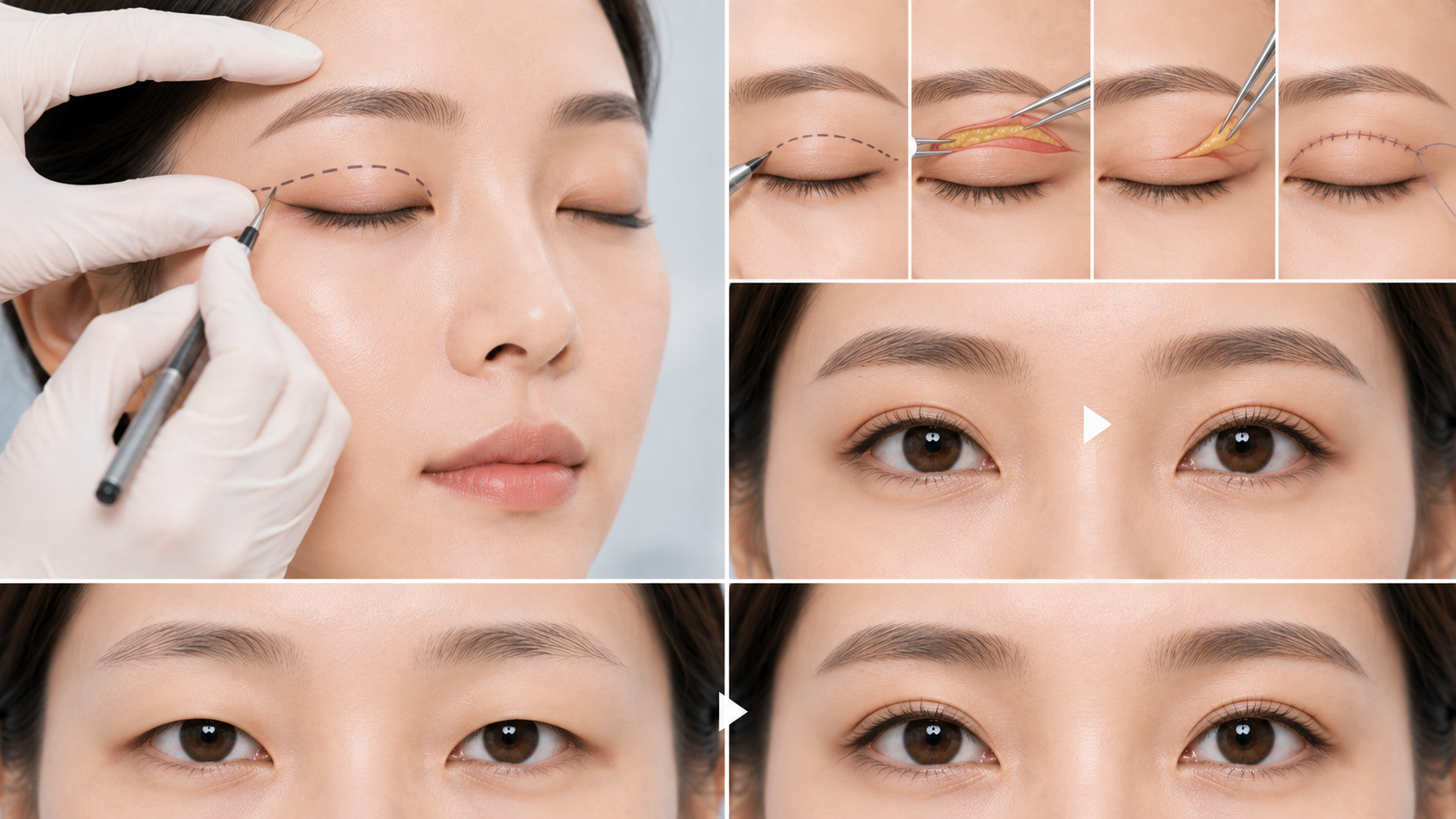
Upper blepharoplasty is the surgical removal of redundant upper-eyelid skin through an incision placed in the natural lid crease, with selected muscle or fat addressed when the examination indicates it.
The incision generally follows the natural upper-eyelid crease, and the planned excess skin is then removed.
Selected muscle or fat tissue may be addressed if that is appropriate for the individual lid.
The incision is closed with fine stitches, and ointment or a dressing may be applied afterwards.
The technique varies from patient to patient rather than following a single template.
The clinic places it among the procedures grouped under Eyelid Surgery.
The reason an examination has to include the brow is that heavy upper lids do not all come from the lid. The American Society of Plastic Surgeons, in its blepharoplasty practice parameter, instructs that the forehead and eyebrow should be evaluated for brow ptosis as part of the physical examination, alongside assessment of the amount of skin on the lids, the distribution of orbital fat and the elasticity of the skin. That document also states that visual field assessment is required for functional blepharoplasty, and that patients with a history of dry eye may need a Schirmer's test — a tear-production test — before a plan is settled.
A patient-facing account from the surgical professions says the same thing in simpler terms. The British Association of Aesthetic Plastic Surgeons, in its information leaflet on eyelid reduction, writes that an upper-eyelid reduction can improve vision, explains that ageing slackens muscle and leaves the skin less elastic so that folds gather in the upper lids, and notes that sometimes there is so much skin that the upper lids hang over the eyelashes. Its guidance for the pre-operative meeting is specific: tell the surgeon about any thyroid disease, high blood pressure, diabetes or eye disorder such as a detached retina or glaucoma, and about every medication including herbal remedies, and expect that the surgeon may want an ophthalmologist to check you.
Who Performs Upper Blepharoplasty at Golden Balance Clinic

Dr. Eun-Young Kwak
Plastic Surgery/Petit Center Doctor
One doctor leads this operation here, and she heads the clinic's plastic surgery and petit centre.
How much skin to take, and whether to touch muscle or fat at all, is a judgement made with the patient sitting in front of you rather than from a photograph, and Dr. Eun-Young Kwak is the physician the clinic lists for it.
Dr. Eun-Young Kwak is a Director and the doctor who leads the clinic's plastic surgery and petit centre. She graduated from Yonsei University College of Medicine. She is a member of the Korean Academy of Women's Aesthetic Medicine, the Korean Aesthetic Wellbeing Society, the Korean Society for Obesity and Plastic Surgery, and the Korean Society of Anti-Aging Medicine, and she previously served as a director of I-Love Petit Clinic and of Petit Queen Clinic.
Beyond those memberships and that degree, the clinic's record does not describe her caseload in this specific operation, and nothing further is claimed here on her behalf.
Who Is a Good Candidate for Upper Blepharoplasty?
Adults with excess upper-eyelid skin, or a related concern that surgery can reasonably address, who are in suitable health.
People holding realistic expectations of what removing skin from the upper lid can and cannot change.
People whose eyelid function, eye health, degree of skin excess and brow position have been examined, including whether the skin is affecting vision.
People for whom a visual-field assessment has been arranged, where excess skin appears to be obstructing the field.
Assessment is individual: an active eye or eyelid infection, significant dry-eye symptoms, an uncontrolled medical condition, a bleeding risk or medicines affecting clotting may mean postponement or further evaluation first.
One caveat deserves its own line. Brow drooping, or another eyelid condition, may need assessing in its own right, because removing upper-eyelid skin alone may not address the underlying concern. A patient who arrives convinced the problem is the lid, and leaves having been told the brow is contributing, has had a useful consultation rather than a disappointing one.
What to Expect: Procedure, Recovery, and Results Timeline
The first step is confirming that the clinic offers upper blepharoplasty, and the second is an honest account of your concerns, your medical history, your current medicines, your allergies, any eye symptoms and any previous eye procedures. An examination then covers upper-eyelid skin, eyelid closure and function, brow position and eye health, with a visual-field assessment where excess skin appears to affect vision. The proposed method, the expected outcome, the risks, the recovery and the follow-up are discussed before anything is agreed.
Preparing is mostly a matter of telling the surgeon everything. Medical conditions, allergies, previous eye surgery and all medicines and supplements belong on that list, particularly anything that may affect bleeding. Prescribed medicines are not stopped unless the clinician advises it. If sedation or general anesthesia is planned, follow the fasting instructions and arrange transport home afterwards.
In theatre the surgeon marks the planned area of skin removal, cleans the area and administers the anesthesia. The incision is generally placed along the natural upper-eyelid crease. The planned excess skin is removed, selected muscle or fat may also be addressed if appropriate, and the incision is closed with fine stitches before ointment or a dressing is applied.
Stage | What the clinic records |
|---|---|
Operating time | Approximately 3 to 4 hours |
Anesthesia | Commonly local; sedation or general anesthesia in selected cases |
Initial recovery | 1 to 2 weeks |
Swelling and bruising | Gradually subside over 3 to 4 weeks |
Visible improvement | 2 to 4 weeks |
Longevity | Results are long-lasting |
Scar maturation | Scars may take several months to soften and fade |
Stay in Korea | About 5 to 7 days as a planning estimate |
Flying home | May be possible after about 5 to 7 days, if the surgeon confirms fitness to travel |
Aftercare is straightforward to describe and tedious to do properly, which is the point. Follow the wound-care and medication instructions, use cold packs and keep the head elevated when resting if advised, and do not rub or press the eyes. Strenuous exercise and swimming wait for the period the surgeon specifies, and the follow-up appointments are attended rather than skipped. Sudden vision changes, severe or increasing pain, significant bleeding, or rapidly worsening redness or swelling all call for urgent medical attention.
The honest range of benefit is this: the operation may reduce excess upper-eyelid skin and improve the appearance of hooded lids, and where that skin obstructs vision it may improve the visual field in appropriately assessed patients. The outcome depends on anatomy, on healing and on how much tissue was removed. It may not correct brow drooping or other causes of eyelid heaviness by itself.
Common temporary effects include swelling, bruising, tightness, numbness, irritation, dry or gritty eyes and blurred vision. Potential complications include infection, bleeding, noticeable scarring, asymmetry, incomplete eyelid closure, under-correction or over-correction, and rarely serious vision problems. The consent literature of the specialty is blunt about the boundaries of the operation: the International Society of Aesthetic Plastic Surgery states in its blepharoplasty consent document that the surgery does not eliminate crow's feet or other wrinkles, nor dark circles under the eyes, nor does it lift drooping eyebrows, while also recording that it can help improve vision in cases where excess skin alters the visual field. The same document lists injury to deep structures such as nerves and eye muscles, which may be temporary or permanent, and notes that secondary surgery may be needed to make additional corrections.
Combining Upper Blepharoplasty with Other Treatments
A brow lift may be considered in selected patients where the examination identifies brow position as a separate contributor.
Another eyelid procedure may be considered where the examination finds a distinct concern that upper-lid skin removal would not address.
Each addition changes the plan, the risks and the recovery, so the decision is made at examination rather than assembled in advance.
Safety, Precision, and Clinic Standards
What follows is quoted from the clinic's published material rather than restated in other words.
The clinic states its philosophy as: "We are committed to personalized 1:1 treatment plans tailored to each patient's condition and prioritize safety above all else in every procedure."
The clinic states that it carries out individualized pre-procedure consultations, limits surgeries to two per day, installs CCTV in all surgery and procedure rooms, and avoids unnecessary over-treatment.
Golden Balance Clinic is registered as a Medical Institution for Attracting Foreign Patients with the Republic of Korea's Ministry of Health and Welfare, under the Medical Overseas Expansion and Foreign Patients Attraction Act. That is a registration for treating international patients; it is not a facility accreditation.
English-language support is available through designated marketing, consultation, and global coordination staff, and the clinic names Scarlett Kim as its global coordinator, available from 10:00 to 20:00 KST.
Golden Balance Clinic is on the 12th floor of the Chunglim Building at 468 Gangnam-daero, Gangnam-gu, Seoul 06123, Republic of Korea. The clinic is open Monday to Sunday from 10:00 to 21:00 KST year-round, with a lunch break from 11:30 to 12:30 KST and last registration at 19:00 KST.
Some of what patients plan around has nothing to do with the operating room. The National Health Service notes in its information on eyelid surgery that most people take about two weeks off work to recover depending on their job, that driving is not possible for a number of days afterwards, and that bruises and redness may take several weeks to fade while scarring may be visible and feel tight for a few months. Its recovery advice includes propping the head up with pillows when resting, applying a cold pack, wearing sunglasses to protect the eyes from sun and wind, and avoiding smoking, contact lenses and rubbing the eyes.
The Bottom Line
The operation removes excess upper-eyelid skin through an incision in the natural lid crease, and may address selected muscle or fat.
Where excess skin obstructs the visual field, surgery may improve that field in patients assessed as suitable for it.
Brow position is part of the examination, because skin removal alone may not address brow drooping or every cause of eyelid heaviness.
Initial recovery runs one to two weeks, swelling and bruising subside over three to four weeks, and visible improvement arrives at two to four weeks.
Results are long-lasting, but scars may take several months to soften and complications include incomplete eyelid closure, asymmetry and over- or under-correction.
Frequently Asked Questions
Can this operation help my vision, or is it purely cosmetic?
It can be either, and the examination decides which. Where excess upper-eyelid skin obstructs the visual field, surgery may improve that field in appropriately assessed patients, and formal visual-field assessment is the recognised step for establishing it. Where the concern is the appearance of hooded lids, the operation is cosmetic and should be discussed on that footing.
Why does the surgeon keep looking at my eyebrows?
Because eyelid heaviness is not always an eyelid problem. Professional guidance directs that the forehead and brow be evaluated for drooping as part of the examination, and the clinic's own record notes that removing upper-eyelid skin alone may not resolve the underlying concern when the brow is contributing to it.
How long is the operation, and what anesthesia is used?
The clinic records approximately three to four hours. It is commonly performed under local anesthesia, with sedation or general anesthesia used in selected cases. Which applies to you is decided with the surgeon, and fasting instructions and transport arrangements follow from that decision rather than preceding it.
When will I look presentable, and when will the scar fade?
Initial recovery takes one to two weeks, with swelling and bruising gradually subsiding over three to four weeks and visible improvement at around two to four weeks. The eyelid contour keeps settling over the following weeks and months, and scars may take several months to soften and fade. The timeline varies between individuals.
What should I expect to feel afterwards?
Swelling, bruising, tightness, temporary numbness, irritation, watery or sensitive eyes, dry-eye symptoms and temporary blurred vision are all common. They generally ease as healing progresses. Sudden vision changes, severe or increasing pain, significant bleeding or rapidly worsening redness or swelling are different and need urgent assessment.
How long should I stay in Korea for this?
Plan on about five to seven days. Confirm with the clinic what the follow-up schedule is and whether stitches need removing before you leave, because that is what the estimate hinges on. Flying home may be possible after the same five to seven days if the surgeon confirms you are fit to travel.
Will it get rid of my crow's feet and dark circles?
No. Removing skin from the upper lid does not eliminate crow's feet or other wrinkles, does not clear dark circles under the eyes, and does not lift drooping eyebrows. Those are separate concerns with separate answers, and a consultation is the place to ask which, if any, of them apply to you.
What do I need to tell the clinic in advance?
Your medical history and eye conditions, your allergies, any previous eye procedures, and all medications and supplements you take — especially anything affecting bleeding. Do not stop a prescribed medicine without medical advice. Follow the clinic's instructions and arrange transport or assistance after surgery if that is needed.
Book a Consultation at Golden Balance Clinic

Upper Blepharoplasty is performed at the clinic in Gangnam-gu, Seoul, and whether skin removal is the right answer for your lids — or whether the brow needs assessing first — is settled by examination, not in advance. Photographs the clinic has recorded can be seen at clinic's gallery.
Contact Golden Balance Clinic through the clinic contact page, by phone on +82-2-516-7148, or by email at info@goldenbalanceclinic.com.
Disclaimer
For informational purposes only. Individual results may vary depending on each patient's medical history, physical condition, anatomy, treatment plan, and recovery. The suitability of gynecological, aesthetic, dermatological, injectable, and other medical procedures should be determined through an individual consultation with a qualified medical professional. All treatments may involve potential risks, side effects, and recovery requirements, which should be discussed before treatment. Information provided by Golden Balance Clinic does not replace professional medical advice, diagnosis, or treatment. Results may vary and individual experiences may differ.
Sources & Further Reading
American Society of Plastic Surgeons — practice parameter for blepharoplasty: evaluation of the forehead and eyebrow for brow ptosis, the requirement for visual field assessment in functional blepharoplasty, and Schirmer's testing where there is a dry-eye history.
British Association of Aesthetic Plastic Surgeons — patient leaflet on eyelid reduction: what upper-lid surgery can improve, why folds develop with age, and what to disclose before the operation.
International Society of Aesthetic Plastic Surgery — informed-consent document for blepharoplasty: the limits of the operation regarding crow's feet, dark circles and brow position, injury to deep structures, and the possible need for secondary surgery.
National Health Service — information on eyelid surgery: typical time off work, driving, how long bruising and scar tightness last, and practical recovery advice.
Other Services
Explore additional treatments offered by our specialists.
Eyebrow Semi-Permanent Makeup
Eyebrow semi-permanent makeup is a cosmetic tattooing procedure that deposits pigment into the skin to enhance eyebrow shape, definition, and color.
Learn More
Facial Contour Micropigmentation
Facial contour micropigmentation refers to depositing pigment into the skin to create or enhance selected facial features.
Learn More
Eyeliner & Eye Enhancement PMU
Eyeliner PMU is a cosmetic tattooing procedure that deposits pigment into the skin around the eyelids to create a longer-lasting eyeliner effect.
Learn More